Heritage Solutions Missing from Victoria’s Climate Resilience Action Plans
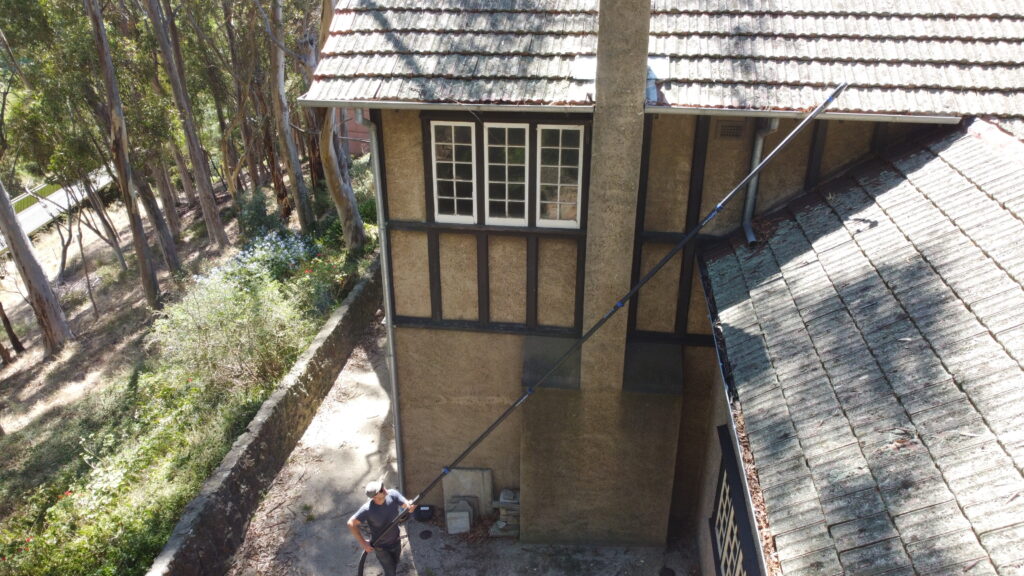
Feature Image: Conservation Team Cleaning Gutters at Waller House
The National Trust has made a submission on the Victorian Government’s draft Adaptation Action Plans 2027–31, which will guide how the state responds to climate change across eight critical systems, including the built environment, energy, education and training, transport, health, the natural environment, primary production and the water cycle.
While we support the overall direction of the plans, our submission identifies a significant gap: heritage is treated almost exclusively as something at risk from climate change, rather than as an important contributor to climate resilience and emissions reduction.
This is not a new issue. In 2021, the National Trust made a submission on the first Built Environment Adaptation Action Plan, resulting in the Victorian Government adopting two of our recommendations in the final 2022–26 Plan: recognising the embodied carbon stored in existing and heritage buildings, and supporting the adaptive reuse of heritage places as an alternative to demolition and new construction. It was a clear demonstration that evidence-based advocacy can influence government policy.
Disappointingly, the new draft plans make no reference to these commitments or to the well-established climate benefits of maintaining, retrofitting and reusing existing buildings. In our latest submission, we renew the case for recognising heritage as part of Victoria’s climate solutions, and expand our recommendations beyond the Built Environment system to also address Education and Training, and the Energy system.
We argue that retaining and adaptively reusing existing buildings can substantially reduce embodied carbon emissions, while strengthening education in conservation principles, traditional trades skills and designing with existing buildings will equip the workforce needed to deliver a more resilient built environment. We also call for greater recognition of the role of public green space and urban tree canopy in creating cooler cities and supporting biodiversity in our urban built environment.
Our Recommendations:
Built Environment — Existing Buildings and Building for the Future
Embodied Carbon
- INTEGRATE heritage conservation explicitly into the Adaptation Action Plans as a climate mitigation and resilience measure, not only as an asset at risk from climate change.
- RETAIN and STRENGTHEN the 2022–26 Built Environment Plan’s commitment to identify and support adaptive reuse of existing buildings as an alternative to new construction, attaching measurable actions, timeframes and funding.
- APPLY disincentives/costs for demolition of existing building fabric (loss of embodied carbon).
- REQUIRE applicants to demonstrate that adaptive reuse has been genuinely explored before a demolition permit is granted, and REQUIRE a planning permit for the replacement building before any demolition permit is issued.
- QUANTIFY and DOCUMENT embodied energy (carbon) savings and environmental benefits of existing building retrofit and adaptive re-use projects.
- REMOVE planning-control exemptions currently available to State Government departments and authorities (e.g. VicTrack, the Departments of Education and Health) for infrastructure projects affecting existing buildings, and REQUIRE State projects to lead by example in retention and adaptive reuse.
Heritage Buildings Maintenance and Reuse
- DEVELOP and IMPLEMENT incentive programs — streamlined approval pathways, rate relief, targeted grants — for retention, retrofitting, adaptive reuse and restoration of heritage and other existing buildings.
- FUND an ongoing revenue stream for the retrofitting and adaptive reuse of existing buildings.
- Reinstate the Living Heritage Grants program to fund heritage conservation works as well as ongoing maintenance to build resilience for Victoria’s heritage buildings and mitigate the need for emergency repairs.
- ENSURE that there is capacity and supplies for managing repairs and maintenance to all building stock by SUPPORTING small trade and manufacturing businesses.
- REVIEW building regulations to recognise traditional and vernacular building typologies and materials, rather than applying uniform contemporary performance measures across all building types.
Public Green Space and Canopy Trees
- RECOGNISE that sufficient green infrastructure, including trees and urban green spaces, are essential to climate change adaptation and liveability within our cities as they become hotter and more densely populated.
- SET and ENFORCE minimum public open space targets for each Local Government Area, calculated against forecast population density rather than current provision, and create minimum service / funding levels to ensure that they are maintained and useable, and new areas of useable public open space can be established where required in areas of greater population density.
- REVIEW and UPDATE Significant Landscape Overlays across Victoria to reflect current values, conditions and climate-change context.
- INCREASE protection of existing canopy trees on public and private land to help deliver the State Government’s 30% Canopy target.
- LEGALLY PROTECT significant trees (those on Council and the National Trust Register of Significant Trees) as a base level for preserving our urban tree canopy. RECOGNISE that new replacement trees will not provide equivalent or adequate benefits for many decades, if at all.
- EXPAND tree canopy protections to ensure tree removal is a last resort. RESOURCE local government to monitor and ensure any replacement canopy trees are properly established and maintained into the future.
- INCREASE penalties for illegal removal of significant trees and vegetation.
- INCENTIVISE private landholders to retain significant trees and privately owned green space and EXPLORE partnership models that expand public access to private green space, e.g. the National Trust/City of Glen Eira residents access arrangement at Rippon Lea Estate (see below).
Education and Training
Workforce Capacity
- IMPROVE trade training in the conservation and retrofitting of existing buildings and ADOPT the following action under the Education and Training Plan: “Strengthen the capacity of the heritage industry and the construction industry more broadly to support sustainable practice in repair, maintenance, management and adaptation of buildings”.
- FUND and DELIVER horticultural, arboriculture and water sensitive urban design training not only for people working directly within these industries, but to the people who plan our towns: Landscape Architects, Architects, Urban Designers and Planners.
- STRENGTHEN education and training for design professionals—including architects, engineers and interior designers—in working with existing buildings, so they have the knowledge, skills and confidence to understand, value and sensitively work with existing building stock.
- LEVERAGE the position of custodians of building portfolios such as The National Trust with funding and support to provide trade training pathways.
Energy
Renewable Infrastructure
- REQUIRE renewable energy infrastructure site assessments to evaluate the impact on biodiversity and land use change as a priority, including full lifecycle impacts — construction, decommissioning and rehabilitation.
- PROTECT national parks, conservation areas and other high-biodiversity sites from renewable energy infrastructure impacts, directing development to lower environmental value sites. ENSURE significant buffer zones are maintained between energy developments and high value areas.
- REQUIRE early, genuine and ongoing community and Traditional Owner consultation in renewable energy project planning, including benefit-sharing.
Read our full submission here.
+ There are no comments
Add yours